
Bubble Letters: Alphabet Guide, Drawing Steps, and Printable Ideas
Learn how to draw bubble letters, choose bubble alphabet styles, make printable letter templates, and design classroom posters, coloring pages, banners, and signs.
Bubble letters are the friendly side of lettering: rounded, oversized, forgiving, and instantly readable from across a classroom, hallway, party table, or poster board. They work because each letter keeps the skeleton of a normal alphabet character, then inflates the outside shape until it feels soft and playful.
This guide covers the full workflow: what bubble letters are, how to draw them by hand, how to style the alphabet from A to Z, when to use printable templates, and how to turn a simple lettering idea into classroom materials, coloring sheets, banners, and digital graphics.
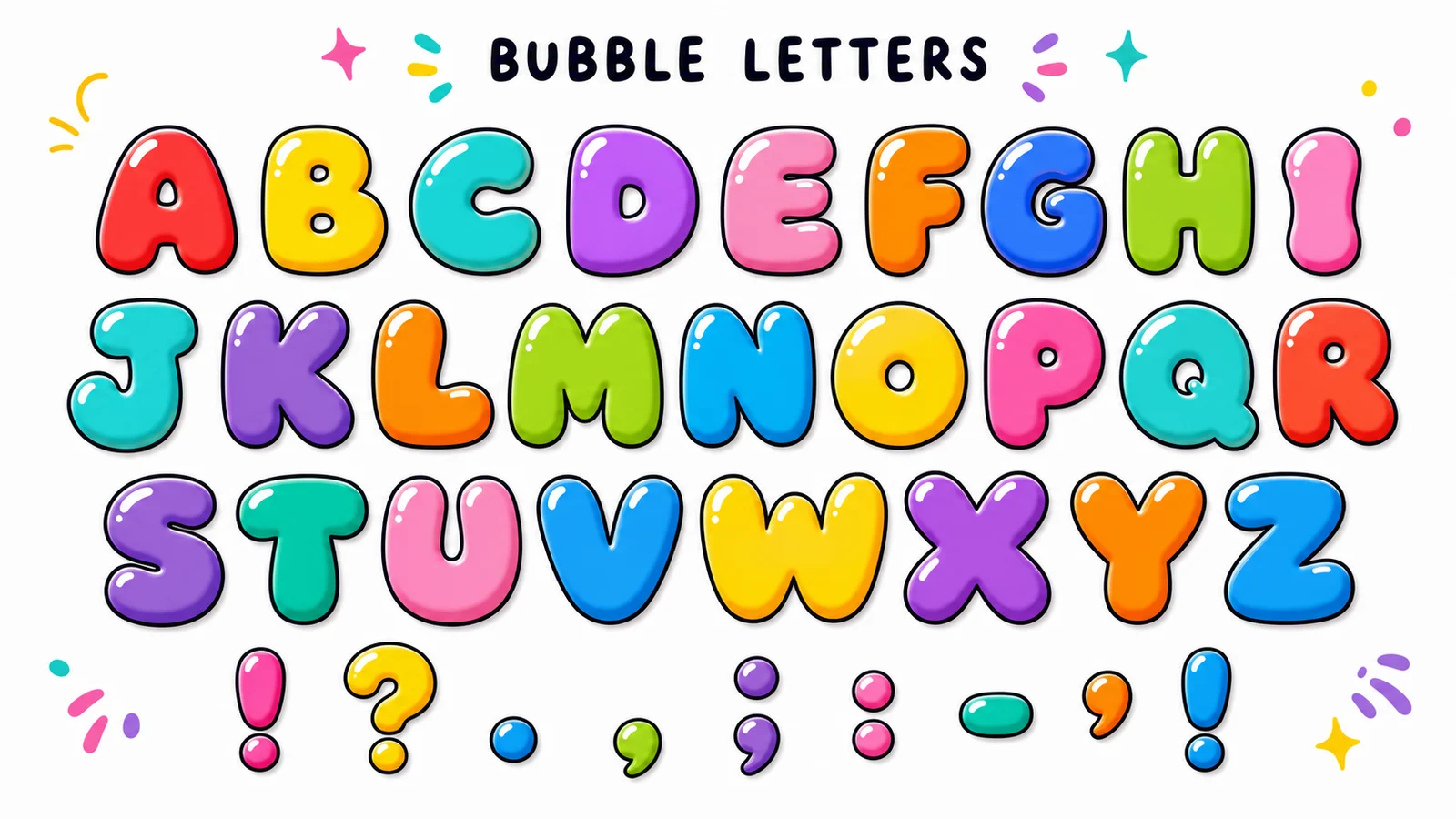
A complete bubble letter alphabet should feel rounded and playful while keeping every letter instantly recognizable.

Coloring Pages Generator
Turn alphabet themes, names, and classroom prompts into printable coloring pages with bold outlines and open spaces.
Create a printable pageWhat Are Bubble Letters?
Bubble letters are letters drawn with thick, rounded outlines so they look inflated or puffy. The style often uses a dark outer stroke, a bright fill color, a small white highlight, and sometimes a drop shadow to make each character pop.
They appear in several common formats:
| Format | Best use | Key feature |
|---|---|---|
| Outline bubble letters | Coloring pages, worksheets, cutouts | Hollow centers and thick borders |
| Filled bubble letters | Posters, titles, banners | Solid color inside each letter |
| Glossy bubble letters | Digital graphics, party signs | Highlights and soft shading |
| Graffiti-style bubble letters | Name art, sketchbooks, murals | Looser forms and stronger shadows |
| Printable alphabet templates | Classroom crafts, bulletin boards | One reusable letter per page |
The search intent behind "bubble letters" is broad. Some people want a drawing tutorial, some want a printable bubble alphabet, and others want a bubble font or generator for a finished design. A strong resource needs to cover all three paths.
Bubble Letter Alphabet: Shape Rules From A to Z
The easiest way to make bubble letters consistent is to think in three layers:
- Skeleton: the normal letter shape, kept simple and readable.
- Inflated outline: the thick rounded body around that skeleton.
- Finish: color, highlight, shadow, or pattern.
Different letters need different treatment:
| Letter group | Drawing advice |
|---|---|
| A, M, N, V, W, X, Y, Z | Round off sharp diagonal joins so they do not feel spiky. |
| B, D, P, R | Keep inner holes large enough that the letter still reads after coloring. |
| C, G, S | Use open curves with enough gap so they do not collapse into blobs. |
| E, F, H, I, L, T | Soften straight bars with pill-shaped ends. |
| O, Q | Treat O as a donut shape; give Q a short rounded tail. |
| J, U | Use a wide bottom curve so the letter feels stable. |
| K | Make the diagonal arms thick but keep the center join clear. |
If a letter becomes hard to identify, reduce the inflation. Readability matters more than maximum puffiness.
How to Draw Bubble Letters by Hand
Art Projects for Kids teaches bubble lettering as a beginner-friendly art project and emphasizes the same core idea: draw fat rounded letter shapes, then add a shadow and highlight. You can use that approach for a single initial, a name, or a full alphabet.
Step 1: Write the Word Lightly
Start with a pencil and write the word in simple block capitals. Keep the letters spaced farther apart than usual. Bubble outlines need breathing room, especially around A, M, W, and double letters such as LL or EE.
Step 2: Draw a Rounded Outer Shape
Trace around each letter with a thick rounded body. Imagine the letter has been wrapped in a soft tube. Corners should become curves, and line ends should become rounded caps.
For beginners, use these simple rules:
- Keep the outline about the same thickness across the whole letter.
- Leave clear counters, which are the holes inside letters like A, B, D, O, P, Q, and R.
- Avoid tiny gaps between letters; they fill in when you color.
- Use larger paper than you think you need.
Step 3: Clean the Inside Lines
Erase the original skeleton lines once the outer shape works. If a letter looks too narrow or too wide, fix it before adding marker. Bubble letters are forgiving, but the silhouette should still read at a glance.
Step 4: Add a Drop Shadow
Pick one shadow direction and keep it consistent. The simplest option is down and right. Draw a second offset outline behind each letter, then fill that shadow with a darker color or gray.
Step 5: Add Highlights
Small white highlights sell the puffy effect. Place them near the upper-left curve of each letter if your shadow falls down and right. Highlights should be simple ovals or short curved strokes, not complicated reflections.
Step 6: Color the Fill
Use markers, colored pencils, crayons, or digital fills. Bright colors work especially well because bubble lettering is meant to feel playful. For a polished look, color the fill first, then reinforce the outer black outline last.
Printable Bubble Letters vs Hand-Drawn Bubble Letters
Hand drawing is best when you want personality. Printable bubble letters are better when you need speed, consistency, or repeated letters for a group project.
| Need | Better option | Why |
|---|---|---|
| One student's name on a folder | Hand-drawn | Personal and quick |
| Full bulletin board title | Printable templates | Consistent letter height |
| Coloring alphabet packets | Printable outline letters | Easy to duplicate |
| Party banner | Printable or generated letters | Fast and scalable |
| Graffiti sketch practice | Hand-drawn | More expressive |
| Digital thumbnails or posters | Generated design | Faster layout and color testing |
If you print bubble letters, choose outline versions for coloring and filled versions for display. For classroom walls, keep the fill high contrast and avoid heavy texture inside the letters.
Design Styles for Bubble Letters
Not all bubble letters should look the same. Match the style to the final use.
| Style | Visual treatment | Best for |
|---|---|---|
| Classic classroom | Black outline, white fill | Worksheets and coloring pages |
| Rainbow alphabet | Each letter a different color | Alphabet posters and bulletin boards |
| Pastel cute | Soft colors, rounded edges | Kindergarten, birthday signs, labels |
| Graffiti bubble | Thick shadows, angled baseline | Name art and sketchbook projects |
| Glossy sticker | Highlights, subtle shadows | Digital covers and social posts |
| Retro bubble font | Rounded 1970s-inspired forms | Posters, invitations, playful branding |
FontSpace's bubble letter category groups hundreds of fonts under related styles such as cute, rounded, poster, graffiti, outline, puffy, and cartoon. That is a useful reminder: "bubble letters" is a shape family, not one fixed alphabet.
Classroom and Craft Ideas
Bubble letters are popular with teachers because they turn ordinary words into display material without requiring advanced art skills.
1. Name Art
Ask students to draw their name in large bubble letters, then fill each letter with patterns that describe them: favorite colors, hobbies, symbols, or small illustrations. This works well as a first-week classroom display.
2. Alphabet Coloring Pages
Create one large outline bubble letter per page. Students can color the letter, add objects that start with the letter, or cut it out for a collaborative alphabet wall.

Thick black outlines and open spaces make a printable page easier for students to color cleanly.
3. Bulletin Board Titles
Use the same bubble alphabet style across the whole board. Limit the title to three to five words, then use smaller text for instructions or student names.
4. Vocabulary Posters
Draw the target word in bubble letters and place examples, synonyms, or diagrams around it. This is especially useful for science and language arts vocabulary.
5. Party Banners
Print one letter per page, trim around each outline, and string the letters together. Filled rainbow letters work well here because they stay readable from a distance.
6. Cut-and-Paste Worksheets
Bubble letters can become movable pieces in early literacy lessons. Students sort letters by sound, build words, or match uppercase to lowercase versions.
Making Bubble Letter Worksheets With Figviz
For a one-off art activity, drawing by hand is enough. For classroom sets, a generator saves time because it can produce consistent line weight, page orientation, and spacing.
Use Figviz's AI Worksheet Generator when you want a structured printable activity. A useful prompt looks like this:
Create a printable worksheet titled "Bubble Letter Name Art".
Include four large blank bubble-letter boxes where students can write their name,
a short pattern idea bank, and a reflection question at the bottom.
Black-and-white line art, thick outlines, plenty of open space for coloring.
Use Figviz's Coloring Pages Generator when you want a single large letter, a themed alphabet page, or an illustrated name sheet.
Create a printable coloring page with the word SCIENCE in large bubble letters.
Add small stars, beakers, atoms, and pencils around the letters.
Bold black outlines, no shading, white background, large open spaces for coloring.
The same printable worksheet structure can be adapted for alphabet tracing, name art, and lettering practice.
Bubble Letters for Posters, Slides, and Digital Designs
Bubble letters can make a title more inviting, but they should not carry every line of text. Use them as display type only.
Good places to use bubble lettering:
- Classroom door signs
- Unit titles
- Birthday banners
- Coloring book covers
- Reading corner labels
- Club posters
- YouTube thumbnails for kid-friendly projects
- Craft fair signs
Avoid bubble letters for long instructions, body paragraphs, citations, small labels, or accessibility-critical text. A rounded display style is fun, but it becomes tiring when used at small sizes.
If you are building a larger classroom visual, pair bubble letter titles with a clean sans-serif body font. For more on legible typography in visual materials, see the scientific poster and figure fonts guide.
Bubble Letter Color Palettes
The right palette changes the mood immediately:
| Palette | Colors | Mood |
|---|---|---|
| Primary classroom | Red, yellow, blue, green | Young, clear, educational |
| Candy pastel | Pink, mint, lavender, peach | Cute, soft, friendly |
| Neon graffiti | Lime, cyan, magenta, orange | Energetic and bold |
| Rainbow sequence | ROYGBIV order | Alphabet charts and celebrations |
| Two-color poster | One fill color plus one shadow color | Clean and easy to print |
| Black-and-white outline | Black stroke on white | Coloring pages and worksheets |
Do not use too many effects at once. A bright fill, a black outline, one highlight, and one shadow are enough for most designs.
Common Bubble Letter Mistakes
Mistake 1: Starting Too Small
Small bubble letters are harder to draw and harder to read. Start large, especially if students will add patterns or coloring.
Mistake 2: Filling the Counters
The holes inside A, B, D, O, P, Q, and R need space. If they get too small, the letters turn into blobs.
Mistake 3: Mixing Shadow Directions
Every letter should share the same light source. If A has a shadow down-right and B has a shadow down-left, the word looks messy.
Mistake 4: Overdecorating the Fill
Patterns are fun, but they can destroy readability. Keep busy patterns inside short words or single initials, not full sentences.
Mistake 5: Using Bubble Letters for Body Text
Bubble letters are display letters. Use them for titles and large labels, then switch to normal type for explanations.
Bubble Letter Prompt Templates
Use these prompts as starting points in Figviz or any image generator that supports printable design prompts.
Full Alphabet Poster
Create a classroom alphabet poster showing uppercase A-Z in colorful bubble letters.
Each letter should have a thick black outline, bright fill color, small white highlight,
and consistent rounded shape. Arrange the alphabet in three neat rows on a white background.
No extra words except the letters A-Z.
Single Letter Coloring Page
Create a printable coloring page featuring one large uppercase bubble letter B.
Use a thick black outline, hollow white interior, and small decorative butterflies,
books, and balloons around the letter. No gray shading, no filled areas, white background.
Name Art Worksheet
Create a black-and-white classroom worksheet for bubble letter name art.
Include a large blank title area, five wide letter spaces for a student's name,
pattern idea icons, and a short reflection prompt. Thick outlines, clean print layout.
Party Banner Letters
Create printable party banner letters spelling HAPPY BIRTHDAY in glossy rainbow bubble letters.
One letter per flag shape, thick black outline, white background, consistent size,
easy to cut out and string together.
FAQ
What are bubble letters?
Bubble letters are thick, rounded letters that look inflated or puffy. They are usually drawn with a bold outline and can be left hollow for coloring or filled with bright colors, highlights, and shadows for posters and digital graphics.
How do you draw bubble letters?
Write a simple block letter lightly in pencil, draw a rounded inflated outline around it, erase the inner guide lines, then add a consistent drop shadow, highlight, and color. Keep the counters inside letters like A, B, D, O, P, Q, and R large enough to stay readable.
What is the easiest bubble letter to start with?
O is usually the easiest because it is already round. After that, try C, U, and L. Letters with diagonals or multiple counters, such as A, B, K, R, W, and X, take more practice because their joins need to stay clear.
Can I print bubble letters for coloring pages?
Yes. Use outline bubble letters with thick black strokes, hollow interiors, and generous white space. One large letter per page works best for young students, while full-name or full-word pages work well for older students and party activities.
Are bubble letters the same as graffiti letters?
Not exactly. Bubble letters are a rounded display lettering style. Graffiti can include bubble letters, but it also includes many other styles such as wildstyle, block letters, tags, and 3D lettering. Classroom bubble letters are usually cleaner and easier to read.
What colors work best for bubble letters?
Bright high-contrast colors work best: red, yellow, teal, blue, purple, pink, orange, and green. Use a dark outline for readability, a small white highlight for shine, and one consistent shadow color for depth.
Can I use bubble letters in a classroom poster?
Yes. Bubble letters are excellent for short classroom poster titles, bulletin board headings, alphabet walls, and door signs. Use them for large display text, then use a normal readable font for instructions or longer explanations.
How can I make bubble letters with AI?
Describe the exact word, alphabet style, color palette, outline thickness, background, and final use. For printable pages, ask for black-and-white line art with thick outlines and no shading. For posters, ask for colorful filled bubble letters with consistent highlights and shadows.
Conclusion
Bubble letters are simple enough for beginners but flexible enough for polished posters, alphabet charts, coloring pages, banners, and digital covers. The core recipe stays the same: readable letter skeleton, inflated rounded body, clear outline, consistent shadow, and restrained decoration.
For printable alphabet activities, start with Coloring Pages Generator or AI Worksheet Generator. For classroom display layouts, Anchor Chart Generator and Graphic Organizer Generator can turn the same playful lettering idea into a full teaching visual.

Coloring Pages Generator
Create bubble letter coloring pages, alphabet sheets, and name art printables in seconds.
Author

Categories
More Posts

Canva Venn Diagram Maker: Full Tutorial and Top Free Alternatives (2026)
Step-by-step walkthrough for building Venn diagrams in Canva, plus an honest look at its weak spots and the strongest free alternatives, including AI tools that build diagrams from plain text.

Bar Chart vs Histogram: Which One Does Your Data Actually Need?
Discover the real distinctions between bar charts and histograms, with concrete examples showing when each chart type is the right tool for your data.

Laboratory Safety Symbols: Signs, Meanings, and Examples
Learn common laboratory safety symbols, what they mean, where they appear, and how to design clear lab safety posters and worksheets.