
Laboratory Safety Symbols: Signs, Meanings, and Examples
Learn common laboratory safety symbols, what they mean, where they appear, and how to design clear lab safety posters and worksheets.
Laboratory safety symbols are visual warnings that tell you what kind of hazard is present and what precaution to take before you touch, open, heat, move, or dispose of something. The most useful symbols do not work alone. They appear with a signal word, a short hazard statement, PPE instructions, a storage rule, or a site-specific lab procedure.
This guide explains the most common laboratory safety symbols, where you will see them, and how to turn them into clear classroom posters, lab handouts, and safety worksheets. It is written for science teachers, students, teaching assistants, and lab coordinators who need a practical reference. It is not a replacement for your institution's safety training, chemical hygiene plan, safety data sheets, or local regulations.

Create a Lab Safety Poster
Turn a list of lab rules, symbols, and PPE requirements into a clean classroom poster or worksheet.
Generate a safety poster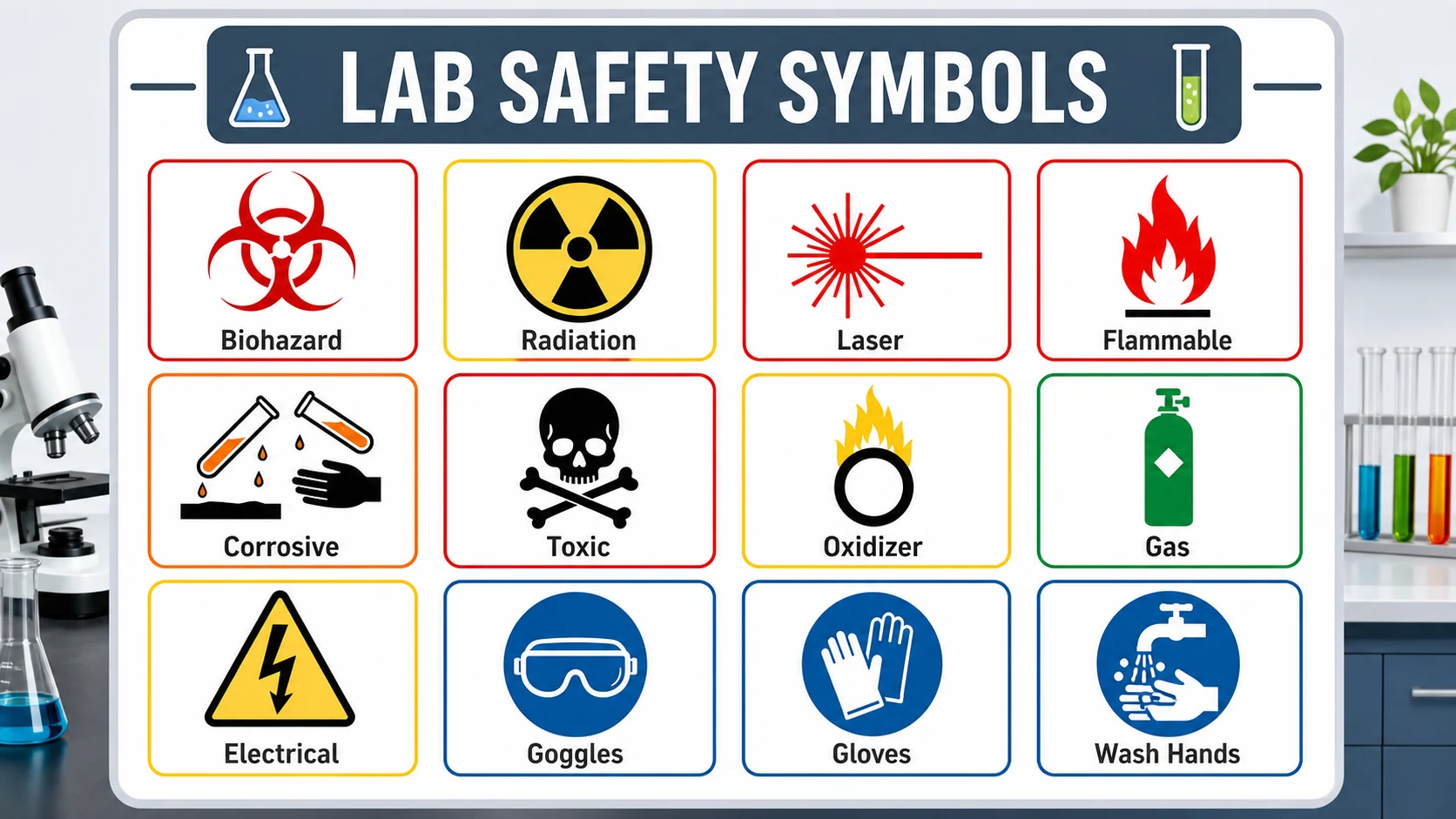
A good lab safety poster groups symbols by hazard type, uses short labels, and leaves the detailed instructions in the lab rules or SDS.
Quick Reference: Common Laboratory Safety Symbols
Use this table as a classroom-friendly key. In a real lab, always pair the symbol with the label text, container information, safety data sheet, and your supervisor's instructions.
| Symbol or sign | What it usually means | Common examples | What to do first |
|---|---|---|---|
| Biohazard | Biological material may contain infectious agents or contaminated waste | Cultures, bloodborne pathogen waste, sharps containers, BSL room doors | Follow biosafety procedures, wear required PPE, and do not remove material from the designated area |
| Radiation trefoil | Ionizing radiation or radioactive material may be present | Radioisotope storage, radiation work areas, sealed source cabinets | Enter only if trained and authorized; follow time, distance, and shielding rules |
| Laser warning | A laser beam may injure eyes or skin | Optical benches, laser cutters, spectroscopy setups, laser pointers in demonstrations | Do not look into the beam; use rated eyewear and beam-control procedures |
| Flame / flammable | Material can ignite easily | Ethanol, acetone, flammable gas, solvent cabinets | Keep away from sparks, flames, heat, and incompatible oxidizers |
| Corrosive | Chemical can burn skin, eyes, metals, or surfaces | Strong acids, strong bases, some cleaning agents | Wear eye and hand protection; use secondary containment and compatible storage |
| Skull and crossbones / toxic | Acute toxicity risk from inhalation, ingestion, or skin exposure | Cyanides, certain pesticides, highly toxic reagents | Avoid exposure routes, use ventilation, and follow the SDS before opening |
| Oxidizer | Material can intensify fire or react strongly with fuels | Hydrogen peroxide, nitrates, perchlorates, oxygen cylinders | Store away from organics, solvents, paper, and flammables |
| Gas cylinder | Compressed gas under pressure | Oxygen, nitrogen, carbon dioxide, hydrogen cylinders | Secure cylinders upright, protect valves, and use the correct regulator |
| Electrical hazard | Shock, arc, or energized equipment risk | Power supplies, electrophoresis units, exposed wiring, wet benches near outlets | Keep hands dry, inspect cords, and power down before adjustments when possible |
| Eye protection required | Safety goggles or face protection are required | Splash-risk labs, heating, glassware, chemical transfer | Put on rated goggles before entering or starting work |
| Gloves required | Hand protection is required | Chemical handling, biological samples, hot or cold materials | Choose glove material for the hazard; change gloves when contaminated |
| Hand washing | Wash hands before leaving or after handling materials | Microbiology labs, anatomy labs, chemical labs, shared teaching spaces | Wash with soap and water after removing gloves and before touching personal items |
Chemical Hazard Symbols: GHS Pictograms
Many chemical labels use the Globally Harmonized System of Classification and Labelling of Chemicals, usually shortened to GHS. In the United States, OSHA's Hazard Communication Standard uses pictograms with a red diamond border for chemical hazard communication. OSHA's hazard pictogram reference is the best starting point for teaching these symbols accurately.
The common GHS pictograms you will see in school and research labs include:
- Flame: flammables, self-reactives, pyrophorics, self-heating chemicals, organic peroxides, and chemicals that emit flammable gas.
- Flame over circle: oxidizers that may cause or intensify fire.
- Corrosion: skin corrosion, serious eye damage, or corrosive effects on metals.
- Skull and crossbones: acute toxicity that can be fatal or toxic.
- Health hazard: carcinogenicity, respiratory sensitization, reproductive toxicity, target-organ toxicity, aspiration hazard, or mutagenicity.
- Exclamation mark: irritants, skin sensitizers, acute toxicity at lower severity, narcotic effects, respiratory tract irritation, or ozone layer hazards where applicable.
- Gas cylinder: gases under pressure.
- Exploding bomb: explosives, self-reactives, or organic peroxides with explosion hazards.
- Environment: aquatic toxicity in systems that use this pictogram.
For a classroom poster, do not list every regulatory category under each icon unless students need that level of detail. A middle school lab poster might say "flammable: keep away from flames." An advanced chemistry lab handout can add storage classes, incompatibilities, and SDS lookup steps.
Examples of Chemical Symbol Placement
Chemical safety symbols can appear on:
- reagent bottle labels
- chemical storage cabinets
- waste containers
- fume hood procedure cards
- stockroom shelving
- SDS summaries
- classroom safety worksheets
The symbol tells the reader what kind of hazard to consider. The label text tells them exactly what to do.
Biological, Radiation, and Laser Symbols
Not every lab symbol is a GHS chemical pictogram. Biology, physics, engineering, and medical teaching labs also use field-specific warning signs.
Biohazard Symbol
The biohazard symbol warns that biological material, contaminated waste, or lab surfaces may pose an infection or contamination risk. In teaching labs, it often appears near microbial cultures, sharps containers, disposal bins, incubators, or room doors.
OSHA's bloodborne pathogens standard includes requirements for labels and signs around certain regulated waste and work areas; see OSHA's 1910.1030 Bloodborne Pathogens page for regulatory language. For classroom use, the most important teaching point is simple: do not treat the biohazard icon as decoration. It marks a controlled material or area.
Radiation Trefoil
The radiation trefoil marks ionizing radiation or radioactive material. In student settings, it may appear in lessons about nuclear chemistry, sealed source demonstrations, medical imaging, or radiation safety posters. Real radiation areas require formal authorization and training.
For teaching diagrams, avoid implying that every trefoil means immediate danger at any distance. The sign is a warning to follow the posted controls: authorization, shielding, time limits, distance, dosimetry, and supervised access.
Laser Warning Symbol
Laser symbols warn that a beam may injure eyes or skin, especially when the beam is direct or reflected. FDA's overview of laser products and instruments is a useful official entry point for understanding why laser products are regulated.
On a lab poster, pair the laser symbol with a concrete instruction: "Do not look into beam," "Use rated eyewear," "Keep beam path below eye level," or "Remove reflective jewelry."
PPE and Mandatory Action Signs
Some symbols do not warn about a hazard directly. They tell you which action is required before entering or working.
Common mandatory signs include:
- Safety goggles required: for splash, impact, glassware, heating, or chemical-transfer work.
- Gloves required: for biological, chemical, thermal, or contamination-control tasks.
- Lab coat required: for clothing and skin protection.
- Face shield required: for splash, cryogenic, or pressure hazards.
- Wash hands: after glove removal, biological work, animal tissue handling, chemical handling, or before leaving the lab.
- Closed-toe shoes required: in teaching and research labs where spills or dropped objects are possible.
These signs work best at decision points: the lab entrance, PPE station, chemical prep area, sink, fume hood, or waste station. If a symbol appears only on a crowded poster at the back of the room, students may not see it when the rule matters.
Facility and Equipment Safety Symbols
Laboratory safety also depends on signs that identify equipment, emergency resources, and building hazards.
| Sign type | Where it appears | Why it matters |
|---|---|---|
| Emergency shower | Near chemical work areas | Helps users find immediate rinsing after a spill or splash |
| Eyewash station | Sinks, benches, prep rooms | Supports fast eye flushing after exposure |
| Fire extinguisher | Walls and exits | Marks fire response equipment for trained users |
| Fire blanket | Teaching labs and prep rooms | Identifies equipment for clothing or small incident response according to local procedure |
| No food or drink | Lab entrances and benches | Prevents ingestion and contamination routes |
| Electrical hazard | Power supplies, panels, wet areas | Warns about energized equipment or shock risk |
| Hot surface | Hot plates, ovens, autoclaves | Prevents burns when equipment looks harmless |
| Sharps | Needle, scalpel, glass, or blade disposal | Prevents cuts and puncture injuries |
OSHA's 1910.145 accident prevention signs and tags page is useful when you need to distinguish signal words such as Danger, Caution, and Warning in a workplace context. ISO 7010 is another widely used safety-sign framework for graphical symbols and safety colors; the ISO overview is available at ISO 7010:2019.
How to Read a Lab Safety Sign Correctly
Students often memorize symbols as isolated icons. In real use, they need a reading sequence.
- Identify the hazard category. Is it chemical, biological, physical, electrical, radiation, laser, thermal, or procedural?
- Read the signal word. Danger, Warning, Caution, Notice, and mandatory-action signs do not carry the same urgency.
- Read the instruction. A symbol without text is incomplete for most lab decisions.
- Check the location. A symbol on a storage cabinet, waste bottle, room door, or instrument has different implications.
- Match PPE to the task. Goggles, gloves, coats, face shields, and respirators are not interchangeable.
- Check the SDS or SOP. Chemical labels and safety posters summarize; they do not replace detailed procedures.
- Ask before acting. If the symbol is unfamiliar, stop and ask the instructor, supervisor, or safety officer.
For a worksheet, turn this into a short exercise. Show a bottle label, a fume hood sign, and a waste label. Ask students to identify the symbol, risk, required PPE, and first action.
Designing a Lab Safety Symbols Poster
A safety poster is useful only if people can read it quickly under real classroom conditions. Treat it as a working reference, not a decorative wall chart.
Use a Grid, Not a Collage
Group symbols into categories:
| Poster section | Suggested symbols |
|---|---|
| Chemical hazards | flammable, corrosive, toxic, oxidizer, gas cylinder |
| Biological hazards | biohazard, sharps, hand washing |
| Physical hazards | radiation, laser, electrical, hot surface |
| Required PPE | goggles, gloves, lab coat, face shield |
| Emergency equipment | eyewash, shower, fire extinguisher, spill kit |
A grid lets students compare symbols without scanning through a busy illustration. Use one symbol, one label, and one short action line per tile.
Keep Text Short
Long paragraphs fail on posters. Use short action statements:
- "Wear goggles before mixing."
- "Keep away from flame."
- "Use the fume hood."
- "Wash hands before leaving."
- "Ask before disposal."
Save detailed procedure text for the handout, SDS station, or lab manual.
Use Color With Meaning
Color should communicate category or urgency:
- red for fire, stop, prohibition, or high danger
- yellow for warning and caution
- blue for mandatory actions such as PPE
- green for emergency equipment or safe-condition signs
- black and white for high-contrast symbol shapes
Never rely on color alone. Use the icon, label, and text together so the poster remains usable for colorblind readers and black-and-white printing.
Make a Labeled Version and a Blank Version
Teachers get more value when a poster becomes a worksheet set. Create:
- a fully labeled classroom poster
- a blank symbol-matching worksheet
- a version with labels but no meanings
- a scenario worksheet with "what should you do first?" questions
If you are making visuals with Figviz, start with a prompt that names the exact audience and output format:
Create a classroom lab safety symbols poster for 9th grade chemistry.
Use a 3 by 4 grid with common symbols: flammable, corrosive, toxic,
oxidizer, compressed gas, biohazard, laser, radiation, electrical,
goggles, gloves, and wash hands. Add one short action line under each.
Use high contrast, accessible colors, and large labels readable from a wall.
Science Drawing Generator
Create clean lab equipment diagrams, worksheets, and classroom safety visuals.
Examples for Classroom and Training Use
Here are practical ways to use lab safety symbols beyond a single poster.
First-Day Safety Walkthrough
Place students in pairs and ask them to find five signs in the lab. For each sign, they write:
- the symbol name
- where it is located
- what hazard or action it indicates
- what they should do before working near it
This turns safety symbols into a map of the room.
Chemical Label Reading Practice
Give students sample labels for common classroom chemicals such as ethanol, sodium hydroxide, copper sulfate solution, and hydrogen peroxide at classroom-appropriate concentrations. Ask them to identify GHS pictograms, PPE, storage concerns, and disposal questions.
Lab Station Cards
Create a small card for each station:
| Station | Symbols to include |
|---|---|
| Heating station | hot surface, goggles, gloves if needed |
| Chemical mixing station | goggles, corrosive or irritant, wash hands |
| Microbiology station | biohazard, gloves, hand washing, no food or drink |
| Electrical station | electrical hazard, keep dry, power off before changing setup |
| Waste station | chemical waste, sharps, biohazard, ask before disposal |
Exit Ticket
At the end of a lab, show one symbol and ask: "What does this warn you about, and what is one action you should take?" This checks actual understanding rather than label memorization.
Common Mistakes to Avoid
- Using symbols without text. Many students can recognize a flame but not explain the specific rule.
- Mixing regulatory and classroom icons carelessly. GHS pictograms, ISO safety signs, and custom classroom icons are not the same system.
- Making every sign red. If every tile looks urgent, nothing stands out.
- Using tiny labels. A poster that looks good on a monitor may fail on a classroom wall.
- Skipping local procedures. A general poster cannot tell students your waste stream, spill response, or emergency contact process.
- Treating PPE symbols as universal. The correct glove or eyewear depends on the task and material.
- Copying a web poster directly. Rebuild the visual for your room, grade level, language, and actual hazards.
Accuracy Notes
Laboratory safety signage is partly universal and partly local. A GHS corrosive pictogram has a defined chemical-hazard role, but a school lab poster, institutional room sign, SDS, and workplace-compliance label may each use the symbol differently. Always check your jurisdiction, institution, chemical hygiene plan, and lab supervisor's rules before publishing safety signage for real work areas.
If you are teaching, make that limitation explicit. Students should learn that symbols are the start of safe behavior, not the end of it.
Sources and Further Reading
This article was reviewed against OSHA's Hazard Communication pictogram reference, OSHA's accident prevention signs and tags standard, OSHA's Bloodborne Pathogens standard, ISO's overview of ISO 7010:2019 safety signs, FDA's overview of laser products and instruments, and Google's guidance on creating helpful, reliable, people-first content.
For more Figviz resources, see the how to illustrate science guide, the scientific infographic design guide, the best fonts for scientific posters and figures guide, and the scientific color palette guide.
FAQ
What are laboratory safety symbols?
Laboratory safety symbols are visual signs that warn about hazards or required actions in a lab. They may identify chemical, biological, radiation, laser, electrical, thermal, PPE, waste, or emergency-equipment information.
Are all lab safety symbols GHS pictograms?
No. GHS pictograms are used for chemical hazard communication, but labs also use biohazard signs, radiation symbols, laser warnings, PPE symbols, emergency equipment signs, and local procedure labels.
What does the biohazard symbol mean in a lab?
The biohazard symbol means biological material, contaminated equipment, or regulated waste may present an infection or contamination risk. It should be paired with biosafety procedures, access rules, PPE, and disposal instructions.
What is the difference between flammable and oxidizer symbols?
A flammable symbol warns that a material can ignite easily. An oxidizer symbol warns that the material can intensify fire or react strongly with fuels, even if it is not itself a fuel.
Why do lab signs use different colors?
Colors help organize meaning: red often marks fire or danger, yellow marks warning or caution, blue marks mandatory actions such as PPE, and green often marks emergency equipment or safe-condition information. Text and icons should still carry the meaning.
Can I use a lab safety symbols poster as my safety training?
No. A poster is a quick reference, not a complete safety program. Real lab safety depends on training, supervision, SDS review, standard operating procedures, emergency plans, and site-specific rules.
What should a classroom lab safety poster include?
A useful classroom poster should include the most relevant hazards in that room, short symbol labels, one action line per symbol, PPE requirements, emergency equipment locations, and instructions to ask before handling unfamiliar materials.
Can Figviz generate lab safety symbol worksheets?
Yes. Figviz can help create lab safety posters, matching worksheets, station cards, and symbol explanation visuals from a prompt. Always review the output against your school's actual lab rules before using it with students.
Author


