
Homologous Chromosomes: Definition, Diagram, and Meiosis Guide
Learn what homologous chromosomes are, how they differ from sister chromatids, and why homologous pairs matter in meiosis, alleles, and inheritance.
Homologous chromosomes are a matched pair of chromosomes in a diploid cell. One homolog usually comes from the mother and the other from the father. The two chromosomes in the pair have the same genes arranged in the same order, but they do not have to carry the same version of every gene. Those different versions are called alleles.
That is the key idea behind the term: homologous chromosomes are similar in gene layout, not identical in DNA sequence. They matter because they explain how diploid organisms carry two copies of most genes, how alleles segregate into gametes, and how crossing over during meiosis creates new combinations of inherited traits.

Create a Meiosis Diagram
Generate labeled meiosis diagrams, chromosome pairing visuals, crossing-over figures, and blank genetics worksheets from a short prompt.
Generate a meiosis diagramQuick Definition
A homologous chromosome pair contains two chromosomes that match in length, centromere position, and gene loci. In humans, most body cells are diploid and contain 23 pairs of chromosomes. Twenty-two of those pairs are autosomes, and one pair is the sex chromosomes.
Here is the short classroom definition:
Homologous chromosomes are chromosome pairs that carry the same genes at the same loci, with one chromosome inherited from each parent.
Use this distinction carefully. A homologous pair is not the same thing as a pair of sister chromatids. Homologs are the maternal and paternal members of a chromosome pair. Sister chromatids are duplicated copies of one chromosome produced during DNA replication.
Homologous Chromosomes Diagram
The diagram below shows the essential features of a homologous pair. The red chromosome represents one parent-derived homolog and the blue chromosome represents the other. Matching gene loci line up across the pair, but the alleles at those loci may differ.
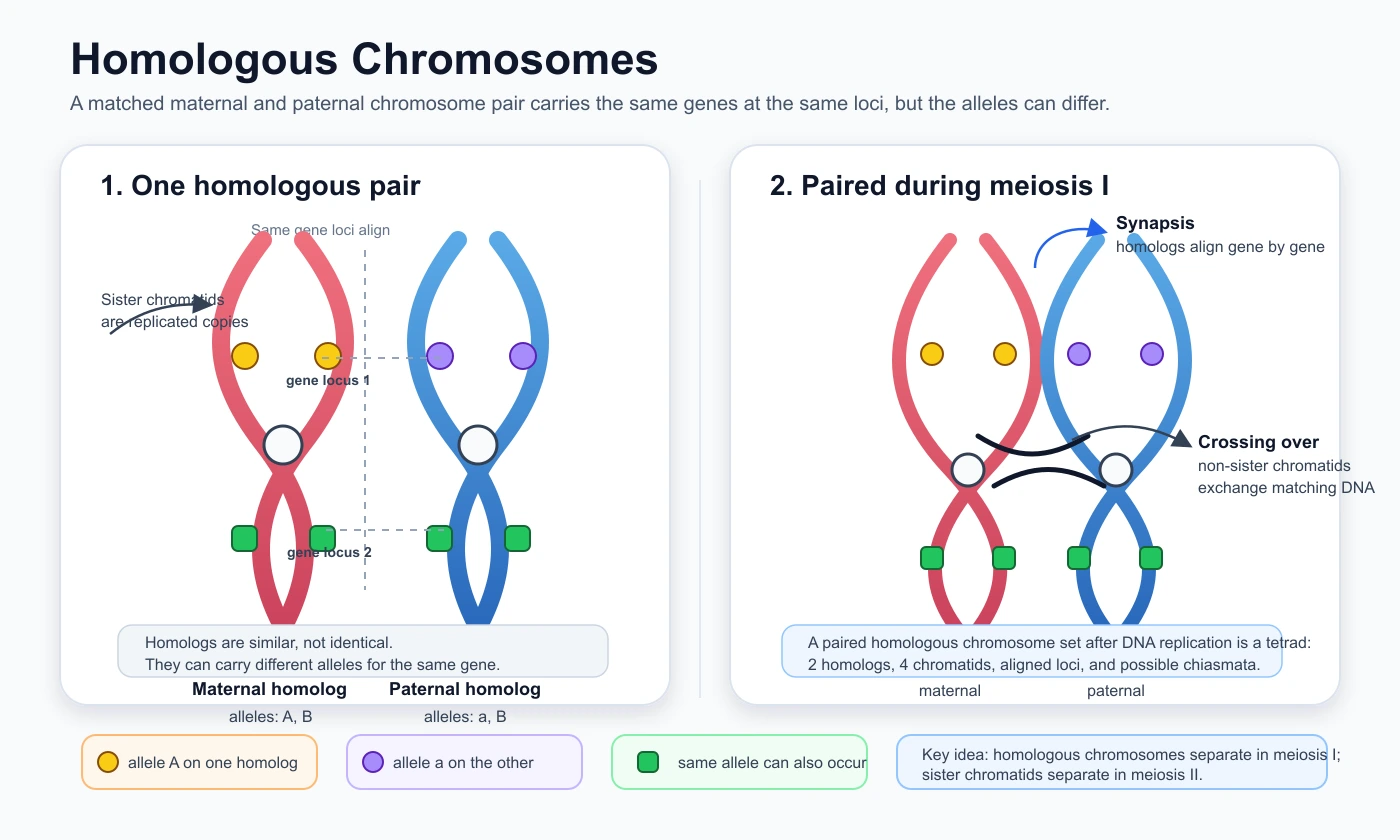
A homologous pair has aligned gene loci. After DNA replication, each homolog has two sister chromatids; during meiosis I, homologs pair and may exchange matching DNA segments.
When reading a chromosome diagram, separate three ideas:
| Feature | What it means | Example in a diagram |
|---|---|---|
| Homologous chromosome pair | Two matching chromosomes, one from each parent | A red chromosome and a blue chromosome with the same length and loci |
| Sister chromatids | Two identical or nearly identical copies of one replicated chromosome | The two arms joined at one centromere on the red homolog |
| Gene locus | A fixed position of a gene on a chromosome | A yellow marker at the same height on both homologs |
| Alleles | Different versions of a gene at the same locus | A vs a at the same locus |
| Chiasma | Visible crossover point between non-sister chromatids | The crossed section where red and blue chromatids exchange segments |
Homologous Chromosomes vs Sister Chromatids
Students often mix up homologous chromosomes and sister chromatids because both can appear as paired structures. The difference is about origin and identity.
| Comparison | Homologous chromosomes | Sister chromatids |
|---|---|---|
| Origin | One from each parent | Produced by DNA replication of one chromosome |
| Genetic content | Same genes, alleles may differ | Usually identical DNA copies before crossing over |
| Centromeres | Each homolog has its own centromere | Sister chromatids share one centromere until separation |
| Relationship | Maternal-paternal chromosome pair | Duplicated copies of one chromosome |
| Separation stage | Separate in meiosis I | Separate in meiosis II and mitosis |
| Main teaching phrase | "Same genes, possibly different alleles" | "Copied chromosome halves" |
Before DNA replication, each homolog is a single chromosome. After replication, each homolog consists of two sister chromatids. A replicated homologous pair therefore forms a tetrad during prophase I of meiosis: two homologous chromosomes and four chromatids.
Why Homologous Chromosomes Matter
Homologous chromosomes are central to genetics because they explain how organisms can inherit two versions of most genes and then pass only one version to each gamete.
They Carry Alleles
At a given locus, the maternal homolog might carry one allele and the paternal homolog might carry another. For example, one homolog may carry allele A and the other may carry allele a. The organism's genotype at that locus depends on the allele combination.
| Allele combination | Genetic term | Simple meaning |
|---|---|---|
AA | Homozygous dominant | Both homologs carry the same dominant allele |
aa | Homozygous recessive | Both homologs carry the same recessive allele |
Aa | Heterozygous | The homologs carry different alleles |
This is why homologous chromosome diagrams should show loci and alleles together. A diagram that only shows two similar chromosomes misses the inheritance logic.
They Segregate During Meiosis
Meiosis reduces chromosome number by half to make gametes. The homologous pair is the unit that separates in meiosis I. Each gamete receives one chromosome from each homologous pair, not both.
This separation is the chromosome-level basis of Mendel's law of segregation. An organism with genotype Aa can produce gametes carrying A or gametes carrying a because the homologs separate.
They Recombine by Crossing Over
During prophase I of meiosis, homologous chromosomes pair closely in a process called synapsis. Non-sister chromatids can exchange matching DNA segments. This exchange is crossing over, and the visible crossover point is a chiasma.
Crossing over does not swap random chromosome pieces. It exchanges corresponding regions between homologous chromosomes. That preserves gene order while creating new allele combinations on each chromatid.
Homologous Chromosomes in Meiosis, Step by Step
The role of homologous chromosomes is easiest to follow through meiosis I and meiosis II.
Before Meiosis: DNA Replication
Before meiosis begins, DNA replication copies each chromosome. Each homolog now has two sister chromatids. The cell still has the same number of chromosomes, but each chromosome is replicated.
Use this wording for diagrams:
Before replication: 2 homologous chromosomes
After replication: 2 homologous chromosomes, 4 chromatids
Prophase I: Homologs Pair
In prophase I, homologous chromosomes find each other and align gene by gene. This pairing is synapsis. The paired structure is often called a tetrad or bivalent.
Crossing over can occur at this stage. After crossing over, sister chromatids may no longer be perfectly identical because one chromatid can contain a segment from the homolog.
Metaphase I: Pairs Line Up
Homologous pairs line up at the metaphase plate. The orientation of each pair is random relative to other pairs. This independent orientation contributes to genetic variation because maternal and paternal homologs are assorted into gametes in many possible combinations.
Anaphase I: Homologs Separate
In anaphase I, homologous chromosomes move to opposite poles. Sister chromatids remain attached at their centromeres. This is the defining chromosome movement of meiosis I.
Meiosis II: Sister Chromatids Separate
Meiosis II resembles mitosis in one important way: sister chromatids separate. By the end of meiosis, four haploid cells are produced. Each has one chromosome from each original homologous pair.
Human Examples
Humans are diploid, so most body cells contain two sets of chromosomes. A typical human somatic cell has 46 chromosomes arranged as 23 pairs.
| Human chromosome set | Count | Homologous relationship |
|---|---|---|
| Autosomes | 22 pairs | Usually homologous maternal-paternal pairs |
| Sex chromosomes in XX individuals | 1 pair | Two X chromosomes are homologous for most teaching purposes |
| Sex chromosomes in XY individuals | 1 pair | X and Y pair in meiosis but are not fully homologous along their entire length |
| Gametes | 23 single chromosomes | Haploid; one member from each pair |
The sex chromosomes are a useful advanced note. X and Y chromosomes share small pseudoautosomal regions that allow pairing during male meiosis, but they are not homologous across most of their length. For introductory biology, most examples use autosomes because they show the standard homologous-pair pattern cleanly.
Homologous Chromosomes vs Homologous Genes
The word "homologous" can appear in different biology contexts. A homologous chromosome is an entire chromosome that matches another chromosome in a diploid pair. A homologous gene is a gene related to another gene by shared ancestry.
| Term | Scale | Meaning |
|---|---|---|
| Homologous chromosomes | Whole chromosomes | Matching maternal and paternal chromosome pair in a diploid cell |
| Homologous genes | Genes or sequences | Genes related by common ancestry |
| Orthologs | Genes in different species | Homologous genes separated by speciation |
| Paralogs | Genes in the same genome | Homologous genes produced by duplication |
For a classroom chromosome diagram, "homologous" usually refers to the maternal-paternal chromosome pair, not to gene-family evolution.
Common Mistakes
Mistake 1: Saying Homologous Chromosomes Are Identical
Homologous chromosomes are not identical copies. They carry the same genes at the same loci, but the alleles can differ. That difference is why heterozygous genotypes exist.
Mistake 2: Calling Sister Chromatids Homologs
Sister chromatids are duplicated copies of one chromosome. Homologs are the two members of a maternal-paternal pair. In a replicated chromosome diagram, one X-shaped chromosome is not a homologous pair. It is one replicated chromosome made of two sister chromatids.
Mistake 3: Separating Sister Chromatids in Meiosis I
In meiosis I, homologous chromosomes separate while sister chromatids stay together. Sister chromatids separate in meiosis II.
Mistake 4: Drawing Crossing Over Between Sister Chromatids
Introductory meiosis diagrams should show crossing over between non-sister chromatids of homologous chromosomes. That is the exchange that creates new allele combinations.
Mistake 5: Forgetting Chromosome Number
After DNA replication, chromosome number has not doubled. The DNA content has doubled, and each chromosome now consists of two sister chromatids. Count chromosomes by centromeres, not by visible arms.
How to Draw a Clear Homologous Chromosomes Diagram
A useful homologous chromosome diagram should make three relationships visible: the homologous pair, the sister chromatids, and the aligned gene loci.
Use this checklist:
- Draw two chromosomes with the same length and centromere position.
- Use different colors for maternal and paternal homologs.
- Mark two or three gene loci at matching positions on both homologs.
- Label alleles at those loci, such as
Aon one homolog andaon the other. - If showing replication, draw each homolog as two sister chromatids joined at a centromere.
- If showing meiosis I, align the homologs as a tetrad and mark a crossover between non-sister chromatids.
- Add a short note that homologs separate in meiosis I and sister chromatids separate in meiosis II.
For worksheets, create both a labeled version and a blank version. In the blank version, leave callout lines for these labels:
| Label to practice | What students should identify |
|---|---|
| Maternal homolog | One chromosome inherited from the mother |
| Paternal homolog | The matching chromosome inherited from the father |
| Sister chromatids | Duplicated copies within one replicated homolog |
| Centromere | The joined region of sister chromatids |
| Gene locus | Same gene position on both homologs |
| Alleles | Different gene versions at a locus |
| Chiasma | Crossover point during meiosis I |
Biology Drawing Generator
Create labeled biology diagrams, genetics worksheets, and clean classroom visuals from a short prompt.
Prompt Templates for Figviz
Use these prompts when you need a homologous chromosome visual for class notes, a worksheet, or a slide.
Labeled Homologous Chromosomes Prompt
Create a clean labeled biology diagram of homologous chromosomes for high school genetics.
Show one maternal homolog and one paternal homolog with the same length and centromere
position. Mark three matching gene loci on both homologs. Label alleles A and a at one
locus, sister chromatids, centromere, homologous chromosome pair, and gene locus.
Use a white background, readable labels, and textbook-style callout lines.
Crossing Over Prompt
Create a meiosis I diagram showing a tetrad of homologous chromosomes during prophase I.
Use different colors for maternal and paternal homologs. Show four chromatids, synapsis,
a chiasma, and crossing over between non-sister chromatids. Label homologous chromosomes,
sister chromatids, non-sister chromatids, chiasma, and recombined chromatids.
Blank Worksheet Prompt
Create a blank homologous chromosomes worksheet. Show two replicated homologous
chromosomes aligned as a tetrad, with empty callout lines for students to label:
maternal homolog, paternal homolog, sister chromatids, centromere, gene locus, alleles,
and crossing over. Use a black-and-white print-friendly style.
Summary
Homologous chromosomes are matched maternal and paternal chromosomes that carry the same genes at the same loci. Their alleles can be the same or different. After DNA replication, each homolog has two sister chromatids. During meiosis I, homologous chromosomes pair, can exchange DNA by crossing over, and then separate. During meiosis II, sister chromatids separate.
If you remember only one rule, use this:
Homologous chromosomes separate in meiosis I.
Sister chromatids separate in meiosis II.
That rule connects chromosome structure to inheritance, allele segregation, and genetic variation.
Sources and Further Reading
This guide was checked against OpenStax Biology 2e on The Process of Meiosis, the National Human Genome Research Institute Chromosomes Fact Sheet, and NCBI Bookshelf's Molecular Biology of the Cell chapter on Meiosis. For SEO and publishing quality, this article was also reviewed against Google's guidance on creating helpful, reliable, people-first content.
FAQ
What are homologous chromosomes?
Homologous chromosomes are a matched pair of chromosomes in a diploid cell. One usually comes from the mother and the other from the father. They carry the same genes at the same loci, but they may carry different alleles.
Are homologous chromosomes identical?
No. Homologous chromosomes are similar in structure and gene order, but they are not identical copies. They can carry different alleles at the same gene loci.
What is the difference between homologous chromosomes and sister chromatids?
Homologous chromosomes are the maternal and paternal members of a chromosome pair. Sister chromatids are duplicated copies of one chromosome produced during DNA replication. Homologs separate in meiosis I, while sister chromatids separate in meiosis II.
How many homologous chromosome pairs do humans have?
A typical human body cell has 23 chromosome pairs. Twenty-two pairs are autosomes, and one pair is the sex chromosomes. Human gametes are haploid and contain one chromosome from each pair.
What happens to homologous chromosomes during meiosis?
During meiosis I, homologous chromosomes pair, may exchange DNA by crossing over, line up as pairs, and then separate into different cells. Sister chromatids remain together until meiosis II.
What is crossing over between homologous chromosomes?
Crossing over is the exchange of corresponding DNA segments between non-sister chromatids of homologous chromosomes during prophase I of meiosis. It creates new combinations of alleles.
Do homologous chromosomes have the same genes?
Yes. Homologous chromosomes carry the same genes in the same order at the same loci. However, the allele version at a locus can be different on the two homologs.
How do you draw homologous chromosomes correctly?
Draw two chromosomes with the same length and centromere position, use different colors for maternal and paternal homologs, mark matching gene loci, and label alleles. If the diagram shows meiosis I, align the replicated homologs as a tetrad and show crossing over between non-sister chromatids.
Create Your Own Homologous Chromosome Diagram
Use Figviz when you need a labeled homologous chromosome diagram, a meiosis I crossing-over figure, or a blank worksheet for genetics practice. Start with the Meiosis Diagram Generator for chromosome-pairing visuals, or use the Biology Drawing Generator for broader genetics and classroom diagrams.
Author


